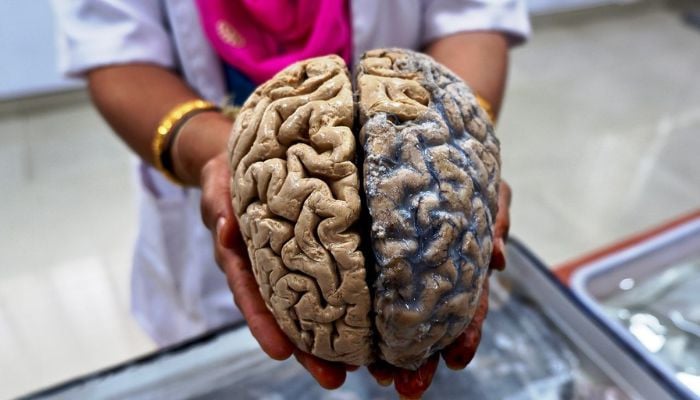
Human brain is actually two separate organs, Stanford study findsFor centuries, scientists have viewed the brain as a single, unified organ. However, new research denies this concept, suggesting that the human brain is actually two distinct organs that have evolved independently over hundreds of millions of years.
The study conducted by Stanford Medicine, published in Nature Neuroscience, found that the front and back of the brain arise from completely different progenitor cells during embryonic development.
One cell type expressing the gene Otx2 develops into the forebrain and midbrain, which regulate language, consciousness, and abstract reasoning. Another, expressing Gbx2, forms the hindbrain, which regulates vital automatic functions like breathing, heartbeat, and sleep.
The senior author of the study, Kyle Loh, said: “We’ve shown for the first time that the front of the brain arises from a totally different progenitor cell than the back.”
The team discovered that these two cell populations never overlap and have fundamentally different chromatin configurations, locking them onto distinct developmental paths. This explains why scientists have struggled for decades to grow hindbrain neurons in the lab, as they were starting with the wrong progenitor cells.
This breakthrough enables researchers to successfully coax human pluripotent stem cells into functional hindbrain motor neurons for the first time. This opens new avenues for studying devastating diseases such as spinal muscular atrophy (SMA) and amyotrophic lateral sclerosis (ALS), which destroy hindbrain neurons and impair swallowing and breathing.
The same pattern was also discovered in chickens, zebrafish, and acorn worms, indicating it arose at least 550 million years ago. Loh said: “Having the brain as one organ would probably be more efficient, but we rely on this primordial way to make the brain as two separate pieces.” The discovery could accelerate regenerative therapies for neurodegenerative diseases.